News & Insights
Does the Future of BI Still Look Like a Dashboard?
For years, the dashboard has been the familiar face of business intelligence (BI), but it seems Microsoft Fabric is beginning to open up another possibility: custom analytical apps built directly on top of the data organisations already hold in Fabric. If those apps become easier and quicker to build, it raises an interesting question: do business analytics even still need a dashboard?
As we know, there was plenty to digest at FabCon this year. One development I keep coming back to, though, is Fabric Apps – partly because of the bigger question it raises about how we’ll use and interact with data.
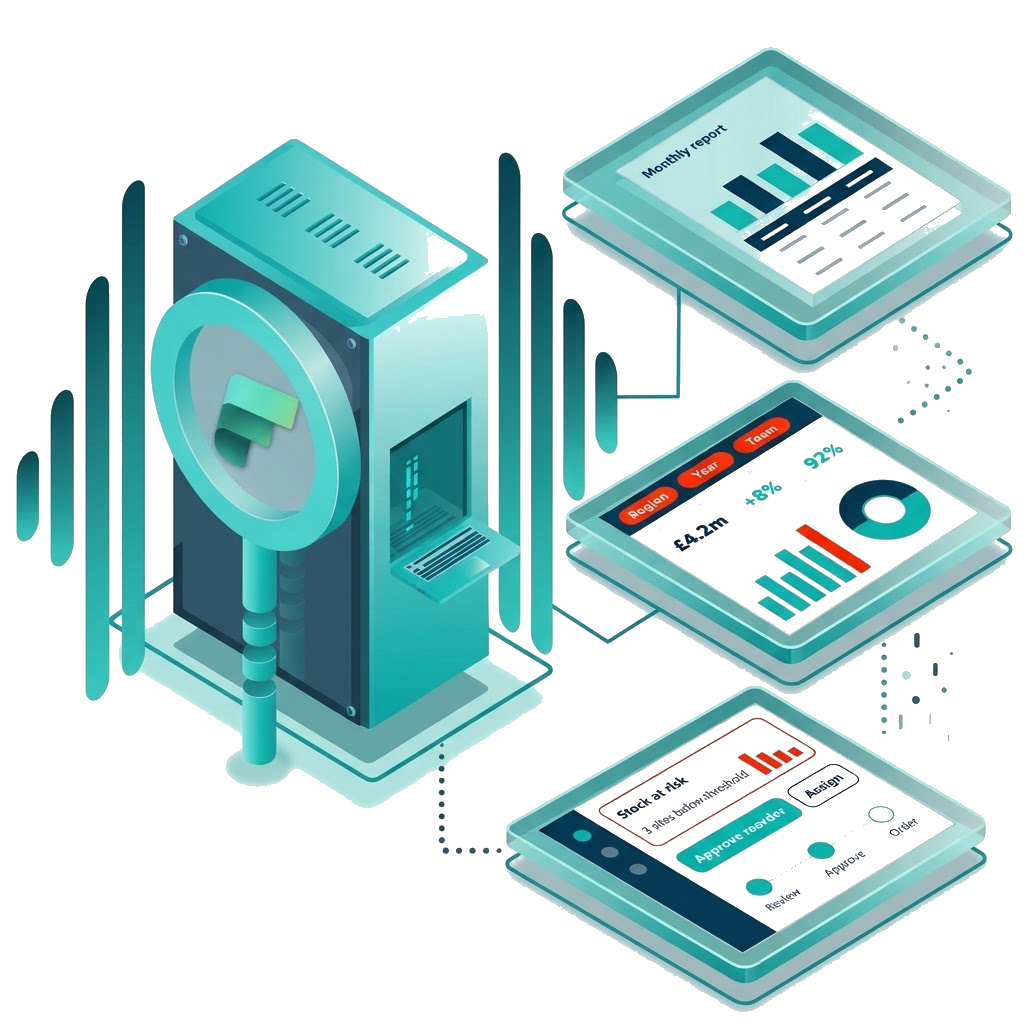
The concept is interesting; Fabric Apps give organisations the ability to create custom applications that sit directly on top of their Fabric data, giving users an experience designed around what they actually need to see, understand, or do.
That got me wondering: If I can quickly build a custom analytical app directly on top of my Fabric data, why do I need Power BI licences at all?
Before anyone starts cancelling subscriptions, that isn’t a prediction that Power BI is about to disappear altogether! Power BI is an established and powerful part of Microsoft’s data estate (and there are plenty of scenarios where dashboards and reports make complete sense).
However, I do think the question is worth asking, as we may be reaching a point where the dashboard is only one way to experience analytics, rather than the default.
Another dashboard, anyone?
For many organisations, consuming analytics has become almost synonymous with opening a dashboard.
Need to understand sales performance? Build a dashboard. Need operational insight? Dashboard. Want to give senior leaders visibility of KPIs? … You can probably guess where this is going.
There’s a good reason we’ve ended up here. BI tools such as Microsoft’s Power BI have made it much easier to turn organisational data into something people can explore and understand without building bespoke software for every requirement.
Still, dashboards remain a particular kind of experience. They organise data around reports, metrics, and visualisations, and ask the user to interpret that information in order to decide what to do with it.
A custom application, on the other hand, approaches this need differently. Instead of beginning with “how do we visualise this data?”, you can begin with the person using it and the job they’re trying to accomplish. The resulting experience might combine data, analytical insight, and the interactions needed to do something useful with what they’re seeing.
In other words, the end point doesn’t necessarily have to be “here’s your dashboard” – it can be an experience built around what someone truly needs to get done.
Custom apps have always been possible. That’s not the interesting bit.
There’s nothing revolutionary about the idea of building an application around data, of course. Organisations have been doing that for decades. Customer portals, operational systems, and workflow applications have long combined data with an experience designed around a particular task, for example.
The catch is that custom development traditionally comes with all the things you would expect: development effort, specialist skills, integration work, and the ongoing cost and responsibility of supporting whatever you’ve built.
Historically, that extra effort has made custom applications harder to justify. If a dashboard gets you 80% of the way there, why invest considerably more time, money, and development effort building something bespoke?
Fabric Apps could change that equation, however. As custom analytical apps become quicker and easier to create, the gap between “let’s build a Power BI report” and “let’s build an application for this” starts to narrow.
Suddenly, choosing a dashboard simply because that’s how your organisation has always consumed analytics deserves a re-think.
First the data, now the apps.
Fabric has already set out to bring much of an organisation’s data world together. Now Microsoft appears to have its sights on another piece of the puzzle: the applications people use to interact with that data. Now, this could make things very interesting for traditional BI …
You see, if your data already lives within Fabric and you can increasingly create purpose-built applications around it, there are suddenly many more options for how people across your organisation consume and interact with analytics. That doesn’t make dashboards redundant, but it does make “analytics = dashboards” a much harder assumption to defend.
Think about the difference between giving somebody a collection of charts and metrics to interpret and giving them an application designed specifically around the decision or process they’re responsible for. Depending on the use case, those could be quite different experiences. Additionally, if creating the latter becomes significantly easier, why wouldn’t we at least consider it?
So, what happens to Power BI?
I don’t think the interesting question is whether custom apps “replace” Power BI. Technology very rarely behaves that neatly, and organisations aren’t going to throw out useful dashboards simply because another option has appeared. For me, the change is subtler, in that Power BI may increasingly become one option within a broader analytics experience, rather than the automatic destination for every requirement.
For some users, a dashboard might remain exactly what they need. Analysts may still want rich exploration and visualisation capabilities (and I don’t see standard reporting requirements suddenly going anywhere). For other users, though, a focused application built around a specific workflow or decision could be considerably more useful.
Once organisations have those choices, other questions naturally follow, e.g., where should you invest your development effort? Which users genuinely need traditional BI tooling? Where could an application deliver a better experience? And, yes, what might all of that eventually mean for your licensing model?
I believe these are more useful conversations to have at this point than declaring either dashboards or Power BI ‘dead’.
Start with user experience
One of the most interesting things about all this is the opportunity to be more thoughtful about how people use data. We’ve become very accustomed to the dashboard as the natural end point for analytics, but Fabric Apps give us good reason to revisit that assumption.
Starting with the person using the data, the decision they need to make, and what they need to do with that information could lead us somewhere quite different. Sometimes that will still be a dashboard. In other cases, a purpose-built application may simply make more sense.
FabCon gave us an early glimpse of what that could look like, and I’ll be interested to see how far Microsoft takes it. Fabric has already been steadily expanding the amount of the data estate it wants to bring together and the prospect of the platform reaching further into the application experience makes its direction even more interesting.
If you’re looking at how Microsoft Fabric could change the way people across your organisation use data, get in touch with Littlefish Group. We’d be happy to explore where Fabric fits within your wider data and AI plans, and what those possibilities could mean in practice.