News & Insights
Dynamics 365 Sales vs SAP

Trying to decide whether Microsoft Dynamics 365 Sales or SAP CRM is the right fit for your organisation? While both platforms help businesses manage customer relationships, they take very different approaches to integration, customisation, AI and user experience.
A modern Customer Relationship Management (CRM) platform plays a key role in how organisations manage leads, nurture opportunities, forecast revenue and build lasting customer relationships. With so many enterprise-grade solutions available, choosing the right platform isn’t always straightforward.
Two of the most widely used CRM solutions are Dynamics 365 Sales and SAP CRM. Both provide the core capabilities you’d expect from a modern CRM, including:
- Managing leads,accounts and opportunities
- Tracking sales activity and pipelines
- Forecasting and reporting
- Workflow automation
The differences emerge in how those capabilities are delivered, how easily they integrate with the rest of your technology estate, and how quickly they can be tailored to your business. To help you assess which option is the best fit, we’ve highlighted some of the key areas where the two platforms differ.
Integration with broader business systems
Dynamics 365 Sales
Dynamics 365 Sales is built on Microsoft Dataverse, enabling seamless integration with the wider Microsoft ecosystem. For organisations already using Microsoft tools such as Outlook, Teams, Excel and SharePoint, this creates a highly connected experience. Sales teams can manage customer interactions, update records and collaborate without switching between multiple systems. Emails with contacts can be linked directly back to Dynamics to ensure consistent tracking of all engagements and contact history.
The platform also integrates natively with Power Platform, allowing organisations to extend functionality through:
- Power BI for sales revenue and forecast reports, visualisations and dashboards.
- Power Automate to automate workflows like lead follow-ups or meeting creation.
- Copilot for AI-driven insights that help personalise customer engagements.
- Power Apps for custom low-code application development.
The result is a more connected environment where data, collaboration and productivity tools work together to support end-to-end business processes.
SAP CRM
SAP CRM is designed to integrate deeply with SAP’s broader enterprise suite, particularly SAP ERP and S/4HANA. This makes it a sensible choice for organisations that have already made significant investments in SAP technology.
SAP offers strong integration capabilities, but they can be more complex to configure and often require specialist expertise to get the most from them. While highly useful, this approach can lead to longer implementation timelines compared to more out-of-the-box integrations.
Solution Customisation
Both Dynamics 365 Sales and SAP CRM are highly scalable platforms, but they differ significantly in how customisation is approached.
Dynamics 365 Sales
Customisation is largely delivered through the Power Platform, enabling organisations to tailor applications, workflows and reporting with minimal coding. A low-code approach empowers both IT and business users to innovate quickly while maintaining governance and security. This gives organisations the flexibility to adapt quickly as business requirements change, without becoming overly dependent on specialist development resources.
SAP CRM
SAP CRM is known for its deep configurability and ability to support complex enterprise-level processes. However, this flexibility often comes with greater technical complexity. Customisation typically requires highly experienced SAP developers and can involve longer development cycles. This can result in increased costs and longer time-to-value compared to more agile platforms.
AI and intelligent automation
Dynamics 365 Sales
Dynamics 365 Sales integrates deeply with Microsoft Copilot to deliver AI-driven insights. These capabilities help sales teams:
- Prioritise high-value opportunities
- Generate email content and meeting summaries
- Identify trends and forecast outcomes
- Receive real-time guidance throughout the sales process
Microsoft’s ongoing investment in AI ensures that these features are continuously evolving and becoming more embedded in day-to-day workflows. There are also agentic AI features that can further enhance sales processes. For example:
- The Sales Qualification Agent: Helps sales agents prioritise the most relevant leads.
- Sales Close Agent: Autonomously analyses deals to equip sellers with insights they need to close deals faster.
- Sales Research Agent: Compiles information to get answers to complex sales questions and turn raw data into clear decisions quickly.
SAP CRM
SAP is also investing in AI through its Business AI strategy, offering predictive insights and automation capabilities. However, compared to Dynamics, AI features may require additional configuration and integration across multiple SAP components.
Understanding your investment
Dynamics 365 Sales
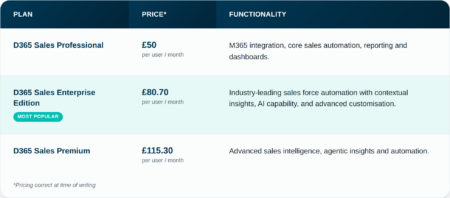
Dynamics 365 Sales often aligns well with existing Microsoft licensing agreements, which can simplify procurement and reduce total cost of ownership. Its modular pricing structure allows organisations to scale functionality as needed.
The different Dynamics plans include:
SAP CRM
SAP CRM pricing can vary significantly depending on deployment model, integration requirements and the broader SAP landscape. While it delivers strong value for organisations already invested in SAP, implementation and maintenance costs can be higher due to technical complexity and reliance on specialist expertise.
SAP Sales Cloud costs $139 per user per month, with the option to add enhancements to your plan for an additional fee. For example, the service add-on is $22 per user per month, while the field sales add-on costs $54 per user per.
Which CRM is right for you?
Choosing the right CRM isn’t about finding the “best” platform. It’s about finding the platform that best fits your organisation’s goals, processes and existing technology landscape.
D365 Sales may be the better fit if you:
- Are already invested in Microsoft 365, Azure or Power Platform
- Want a user-friendly, intuitive CRM with rapid adoption
- Value embedded AI and automation within everyday workflows
- Need flexible, low-code customisation capabilities
SAP CRM may be better suited if you:
- Have significant investment in other SAP solutions
- Need highly complex, industry-specific functionality for large enterprises
- Have in-house SAP expertise
Ultimately, the final decision should be guided by how well the platform aligns with your people, processes and technology strategy, ensuring your CRM investment delivers long-term value and growth.
Still weighing up your options? Our team can help you assess your requirements, explore the strengths of each platform, and choose a CRM that supports your long-term growth and customer engagement goals.