News & Insights
Microsoft AI Tour for Partners: Key Takeaways
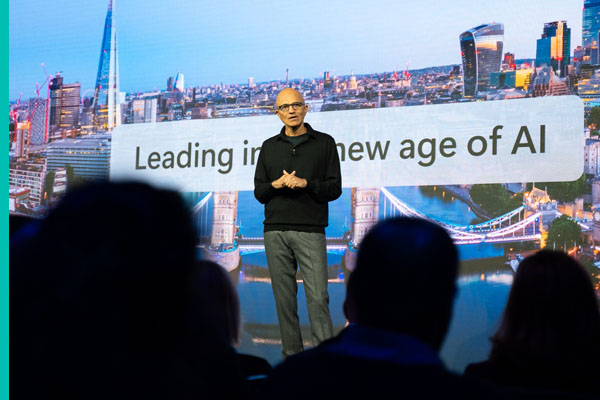
Yesterday, I had the privilege of attending the Microsoft AI Tour for Partners in Westminster, hosted by Microsoft UK CEO Darren Hardman. The event brought together Microsoft and its core UK partner ecosystem to share not just where Microsoft’s AI roadmap is heading, but how organisations can realistically adopt and operate AI at scale.
What stood out most was just how clear Microsoft’s message was. AI is no longer a side initiative or something to experiment with on the margins, it’s now a foundational layer of the Microsoft Cloud, embedded end to end across Azure, Microsoft 365 Copilot, Dynamics 365, Microsoft Fabric and the Power Platform.
The focus has shifted decisively away from innovation theatre and towards execution: delivering real outcomes and building the operational maturity needed to run AI confidently at scale.
AI as a built in capability, not a bolt on
A consistent theme throughout the day was that AI should not be treated as a standalone solution. Instead, Microsoft is embedding AI across the full technology stack, designed to work with existing services, security models and operating practices.
This is particularly evident in the evolution of Copilot. Rather than being positioned as a single productivity assistant, Copilot is increasingly presented as a common AI layer that spans workloads and can be extended, customised and governed in line with how organisations actually operate. The emphasis is on grounding AI in enterprise data, business workflows and line of business systems, rather than relying on generic, disconnected experiences.
The implication for customers is that real value from AI comes when it is designed into core processes, not trialled in isolation.
From experimentation to measurable outcomes
Microsoft was very clear that the market has moved beyond early experimentation. The conversation has shifted to delivery and real‑world impact – how AI is genuinely improving productivity, supporting better decision‑making, automating complex processes and enabling more engaging digital experiences.
Across the sessions, the emphasis consistently came back to outcomes rather than features. AI is increasingly expected to earn its place by delivering tangible benefits, whether that’s freeing up time by reducing manual effort, accelerating insight, improving service quality or opening up new ways of working. This represents a noticeable step change in maturity; and one that many organisations are actively working through.
Copilot sits at the centre of this journey. It’s evolving quickly from a general‑purpose assistant into a broader platform capability, one that can be shaped and extended through custom copilots, agents, plugins and automations built with Azure AI services and the Power Platform. Crucially, all of this is designed to sit within the same identity, security and compliance framework as the wider Microsoft Cloud, helping organisations innovate with confidence.
Security, trust and responsible AI by design
Responsible AI was not treated as an afterthought. Instead, it was framed as a non negotiable design principle.
Microsoft repeatedly reinforced that AI workloads must align with zero trust principles and inherit the same security, auditability and compliance posture as the rest of the platform. Capabilities such as Microsoft Entra for identity, Microsoft Purview for data governance and Microsoft Defender for security were positioned as foundational enablers of trusted AI adoption.
For UK customers and regulated industries, this focus on data residency, tenant isolation, customer data boundaries and interaction logging is particularly important. The message was clear: AI must operate within existing regulatory frameworks, including GDPR, the UK Data Protection Act and sector specific compliance obligations. Trust is not created by limiting AI adoption, but by designing it responsibly from day one.
Operational maturity: the missing piece for many organisations
One of the most valuable aspects of the day was the attention given to operational reality. Microsoft acknowledged that many organisations do not struggle to deploy AI, they struggle to run it reliably, securely and cost effectively over time.
Topics such as FinOps for AI, model lifecycle management, performance monitoring, incident response and service ownership featured prominently. These are not abstract concerns; they directly impact whether AI initiatives scale successfully or stall after initial enthusiasm.
This reinforces the importance of treating AI as a long term operational capability, not a short term project. Design decisions made early – around architecture, data, governance and support – have a significant impact on resilience, cost control and customer trust over time.
Partners as the engine of delivery
The role of partners was central throughout the event. Microsoft’s position was unambiguous: partners are where AI strategy becomes real world delivery.
From advisory and readiness assessments, through data modernisation and secure architecture, to integration, change enablement and managed services, Microsoft expects partners to lead. There was also a strong push towards industry focus, encouraging partners to move beyond horizontal use cases and invest in repeatable, sector specific solutions and accelerators that deliver clear business outcomes.
This reflects a broader shift in the partner ecosystem – away from one off implementation and towards sustainable, outcome driven services that help customers adopt AI with confidence.
What this means for us
For Littlefish Group, the themes from the Microsoft AI Tour closely align with our strategic priorities. The opportunity is not simply to enable AI features, but to help customers adopt AI in a way that is secure, compliant, operationally sound and commercially sustainable.
That means embedding AI into managed services, designing for scale and multi tenancy, and ensuring customers achieve sustained value rather than short lived experimentation. It also means helping organisations build the operational and governance foundations required to trust AI as part of their core digital estate.
As Microsoft’s AI roadmap continues to evolve, our focus remains on translating that direction into practical, real world outcomes for our customers. If you’re exploring how AI fits into your organisation, now is the time to move beyond experimentation. Get in touch to explore how we can support your AI journey.